Cooperative Board Games for Family Game Nights: here's what actually helps. The Johnsons are gearing up for October. It's not just because of the football, fall foliage, or crisp air. There's a more important reason why this month is on the Johnsons' radar: National Family Fun Month.
Why Cooperative Board Games Are a Hit for Mixed Groups
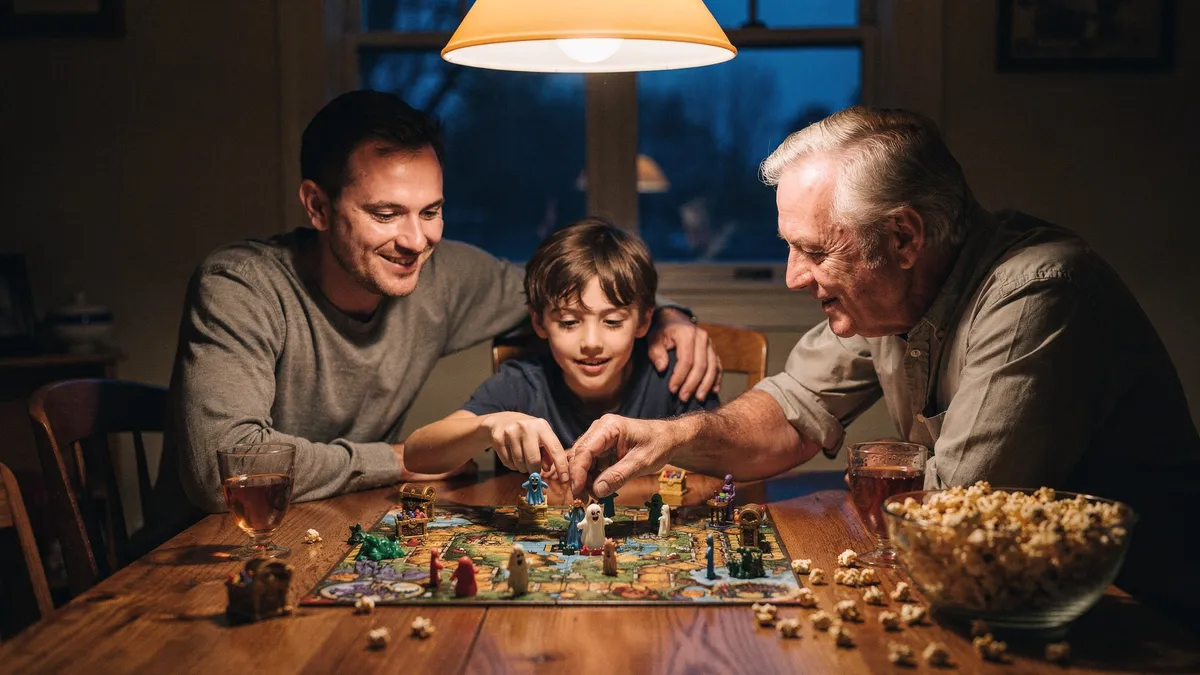
Sure, the Johnsons will celebrate with traditional activities like apple picking or trick-or-treating. But since September is also National Hobby Month, Mr. "Finding activities that engage everyone from my nine-year-old son to my retired parents can be challenging -" he says.
Mr. Johnson's right to look for a new hobby. And while that study found that a competitive game encourages slightly more of those kinds of behaviors than a cooperative one, it also found that intergenerational board games elicit positive affects in participants.
So what's the difference between a competitive game and a cooperative one? You likely know how competition works: Players are pitted against each other, and only one person wins. But in a cooperative board game, players play as a team against the game, planning their strategy together - and if they win or lose, they do it together. This set-up instantly solves the problem of family game nights being difficult with different ages and abilities.
Ghost Fightin' Treasure Hunters: A Cooperative Board Game for Family Game Nights
This lightweight adventure game has simple rules and takes only 30 minutes to play. Recommended for ages 5+, Ghost Fightin' Treasure Hunters puts its players on a steamer bound for Creep Island in search of treasure. But beware: The ship's cargo hold is filled with ghosts out to sabotage the quest and claim the riches for themselves. Work together to find the treasure before the ghosts win the day.
"I'm always looking to design games that help build community and cooperation," Leacock said. "In today's world, these are very important skills that seem to be in short supply."
What Makes a Cooperative Board Game Worth Playing
A good cooperative game needs to be fun and engaging - of course, but what else should you look for? Leacock has high standards. He says to look for a game that's "fairly deep strategically but easy to learn," and that "doesn't drag on." Oh, and it should have "enough luck so that everyone comes across as they have a chance to contribute to the win," he adds.
One way to ensure that everyone has a decent chance at helping to win is to look for a game that has role-playing cards. In GFT Hunters - for example, players choose Character cards that determine their special skills, which include:
- The Map Reader: Can see better in the dark.
- The Strong Man: Can move heavier items.
- The Distractor: Can try to scare off a ghost.
- The Lock Smith: Can tap into locked treasure chests more easily.
- The Scout: Can search two areas at once.
In Pandemic, players choose similar Role cards that give them special talents, such as:
- The Medic: Can remove disease cubes from the board more quickly.
- The Scientist: Only needs four cures to win .
- The Researcher: Can help other players discover cures.
- The Operations Expert: Can place research stations on the board more easily.
- The Quarantine Specialist: Can remove any color cube from any part of the board.
More Cooperative Board Games Worth Trying
Another board game perfect for National Family Fun Month is Kraken Attack! (2011). This aquatic adventure game - recommended for ages 5 and up and with a playing time of 25 minutes, puts players on a pirate ship that sets sail to find buried treasure. But then a monstrous kraken emerges from the depths, threatening to sink the ship and steal the treasure for itself. Players need to work together to fight off the kraken and rescue the treasure before the ship sinks.
As the global population aged over 60 is expected to double by 2050 and more than triple by 2100, games that engage families across generations will become more important than ever. So this National Family Fun Month, consider playing a board game and sticking around for another round … or two.
Further reading
- https://pmc.ncbi.nlm.nih.gov/articles/PMC12235071/
- https://coopboardgames.com/blog/how-teamwork-mechanics-shape-modern-co-op-board-game-design/
- https://minifiniti.com/blogs/game-talk/how-to-design-cooperative-board-games-6-key-tips/
- https://herotime1.com/academy/design/board-game-statistics/
Disclaimer
This article is a personal reflection shared for general informational purposes only. It is not medical or health advice, and it is not a substitute for care from a qualified professional. Please talk to your doctor about your own health.