The dirty secret of yard work is that most of the effort goes into fighting your own equipment: the trimmer line that will not feed, the pruner that crushes instead of cuts, the wheelbarrow that tips sideways with every load. A low-maintenance yard starts with tools that remove those fights. This guide covers the handful worth owning, organized by chore, with real models, prices as of mid-2026, and the honest weak point of each one. Links go to manufacturer pages with no affiliate strings attached.
Cutting and pruning
Fiskars PowerGear2 pruner and lopper
Hand pruners are the tool you will touch most in any yard, and Fiskars owns the value end of the category for a reason. The PowerGear2 line uses a cam mechanism that multiplies your grip force through the middle of the cut, which is exactly where thick stems stall a cheap pruner. The bypass pruner runs around $25 to $30, and the matching lopper for branches up to about two inches costs around $40 to $50. Both come with a lifetime warranty Fiskars actually honors. They fit any homeowner maintaining shrubs, roses, and small trees. The honest limitation is long-term serviceability: unlike the roughly $70 Felco F-2 that professionals carry, every part of which can be replaced, the Fiskars is essentially a sharpen-until-done tool, and the geared head adds bulk that feels awkward for delicate snips.
Weeding without a chemical program
CobraHead Original weeder
The CobraHead Original is a simple curved steel finger on a composite handle, made in Wisconsin, that costs around $30. The hooked blade gets under a weed's root instead of decapitating it, which is the difference between weeding a bed once a month and mowing the same dandelions weekly. It also doubles as a furrow tool for planting. It suits anyone with mulched beds, vegetable gardens, or the strip along the driveway where everything sprouts. The honest limitation: it is a hand tool, full stop. You work kneeling, it is slow across large areas, and gravel or heavy clay will make you wish for a stand-up tool or a thicker layer of mulch, which remains the real low-maintenance weed strategy.
Edges and trim
Ego Power+ ST1521S string trimmer
String trimmers generate more equipment rage per minute than anything else in the garage, most of it about line. Ego's ST1521S sidesteps the worst of it with PowerLoad, a head that winds new line at the push of a button after you feed it through, plus a carbon-fiber shaft and a 56-volt battery that handles a typical suburban lot on one charge. It costs around $220 to $250 with battery and charger as of mid-2026. It fits homeowners who want gas-level cutting power without fuel, carburetors, or pull cords. The honest limitations are weight and ecosystem: it is heavier than budget electric trimmers, and the price only makes sense if you stay in Ego's battery platform, since batteries are the expensive half of every cordless system.
Hauling
Gorilla Carts poly dump cart
A wheelbarrow asks you to balance the load; a four-wheel cart does not. Gorilla Carts' poly dump carts, in the 4-cubic-foot class rated around 600 pounds, cost roughly $100 to $130 and have become the default upgrade for moving mulch, soil, stone, and bagged anything. The quick-release handle tips the tub to dump a load without shoveling it back out, and the poly tub shrugs off the rust that ends steel carts. It suits anyone who moves material more than twice a year. Honest weak point: the pneumatic tires. They go flat in storage, they will eventually need a tube or foam-fill, and the no-flat versions trade that chore for a harsher ride. It also eats significant garage floor space, which a hung wheelbarrow does not.
Watering that runs itself
Soaker hoses and a mechanical timer
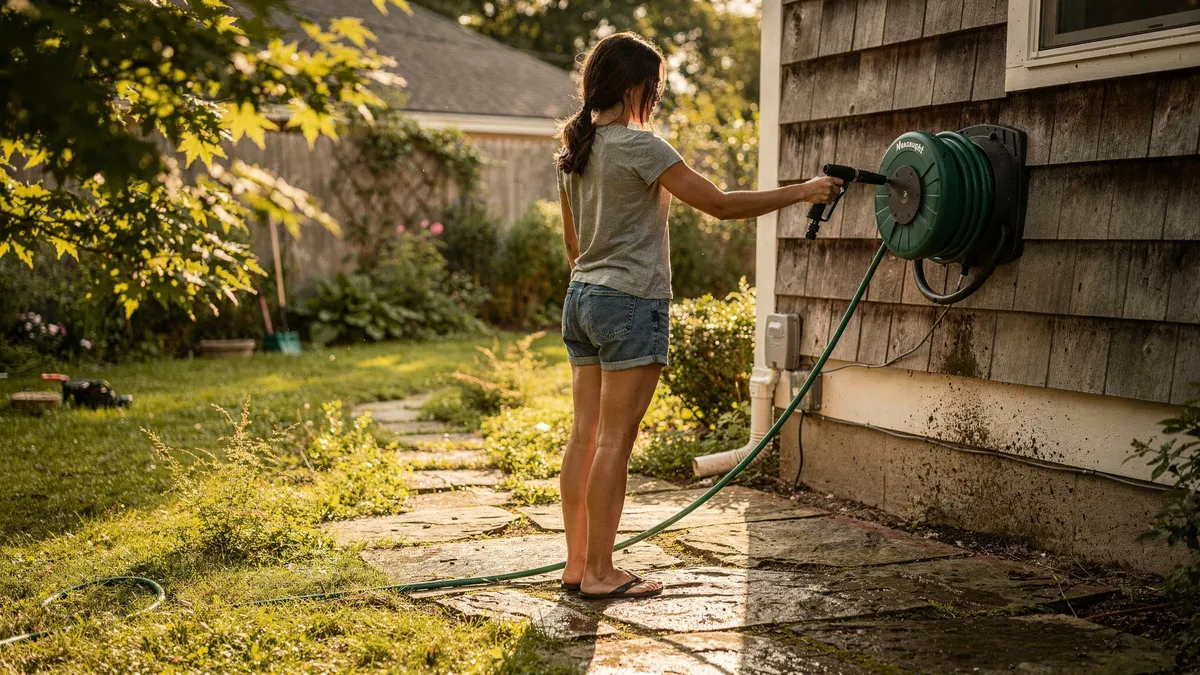
The cheapest labor-saver in this guide is not a brand at all. A soaker hose snaked through beds under the mulch, fed by a basic mechanical spigot timer, waters roots directly with no evaporation loss and no standing around with a nozzle. Expect around $20 to $30 for fifty feet of quality soaker hose and $10 to $15 for a twist timer; add a backflow preventer if your local code asks for one. This setup fits every bed and border on a small lot. The honest limitations: soaker hoses clog gradually with mineral deposits and typically last three to five seasons, output along a long run is uneven past about seventy-five feet, and unlike a smart controller nothing skips the watering after a rainstorm unless you remember to turn the timer.
The judgment calls: mowers and blowers
Two categories deserve a mention without a specific pick, because the right answer swings hardest with lot size. Battery mowers in the 21-inch self-propelled class from Ego, Toro, and Greenworks have genuinely caught up with gas for lots up to about a third of an acre, at prices running roughly $500 to $700 with batteries; beyond that size, battery costs stack up fast and gas or riding equipment still wins the math. Handheld battery blowers in the $150 to $250 range from the same brands handle walkways and light leaf duty fine, and their honest limitation is simply physics, since wet November leaf mass wants a backpack unit or a tarp and a rake.
Keeping the tools low-maintenance too
Tools only stay effortless if they get ten minutes of care a season. Wipe pruner and lopper blades with an oily rag after wet work so sap and rust never build up, and touch up the edge with a $10 sharpening stone each spring, since a dull blade is what turns clean cuts into crushed stems. Store lithium batteries indoors at partial charge over winter rather than in a freezing garage, drain hoses and timers before the first hard frost, and check cart tire pressure when you check the car's. That small routine is the difference between buying this list once and buying it again in four years.
What you can skip
Plenty of heavily marketed gear does not survive contact with a real yard. Manual lawn aerator sandals, stand-up weed pullers with plastic claw mechanisms, and multi-head tool systems that swap between rake, hoe, and broom mostly trade durability for novelty. The five-dollar hose nozzle fails in a season, though its twenty-dollar metal replacement is not really a landscaping strategy either. The pattern behind everything in this guide is the opposite of gadgetry: one well-made tool per chore, a battery platform chosen once, mulch doing the weed work, and water on a timer. Buy that short list and the yard starts asking for hours a month instead of every weekend.