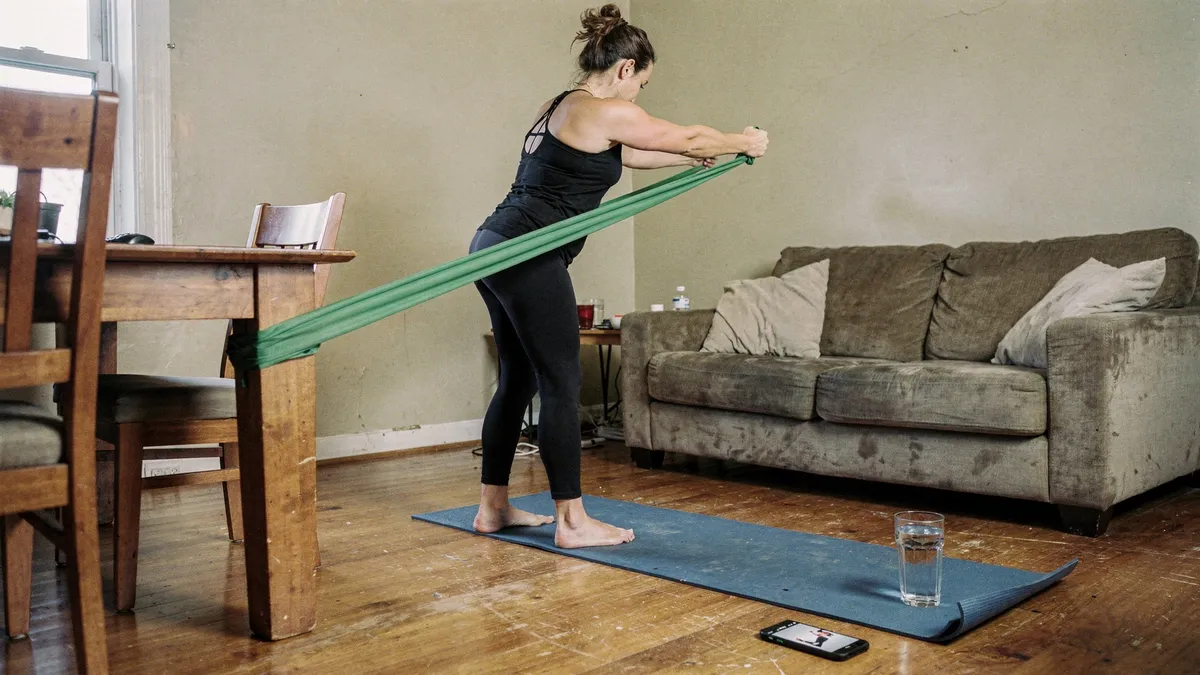
Looking for a simple, low-cost way to strengthen muscles and improve fitness? You might consider trying resistance bands.
Resistance Bands For Beginner Home Workouts: What Are Resistance Bands and How Do They Work
Resistance bands are large elastic or fabric bands used for strength training and improving balance, flexibility and mobility in all areas of the body. They come in a variety of colors, sizes, widths - lengths, thicknesses and levels of resistance (light to heavy). The wider the band, the easier it's to stretch; the thinner the band, the harder it's to stretch and the more resistance it provides.
Some have handles, while others don't. The bands may be looped around your feet or anchored to furniture - such as the leg of a chair. Then you pull, push or press against the band with your arms or legs to provide resistance and strengthen specific muscle groups. The bands are lightweight and portable, which makes them easy to use almost anywhere - at home, outdoors or even in a hotel room when traveling.
Evidence Supporting Resistance Bands for Beginner Home Workouts
The use of elastic resistance training (ERT) as a modality and clinical tool became popular in the 1980s and has been increasing in recent years. A number of studies, including some funded by the National Institutes of Health (NIH) - have shown that performing exercises with resistance bands can be just as effective as using free weights or machines at the gym for increasing muscle strength. One NIH-funded study found that using resistance bands for strength training was safe and effective for older adults.
Other research showed that exercise programs using resistance bands helped women with osteoporosis gain muscle strength and increase flexibility, which may help decrease bone fractures. According to the study authors, on average, 50% of people who adopt conventional resistance training give up during the first year. They believe that resistance training with bands may be more appealing to sedentary individuals because it's more affordable, requires less learning and can be easily incorporated into daily routines. As with any new exercise program - be sure to talk with your health care provider first.
How to Get Started With Resistance Bands Safely
To get started, all you need are a few inexpensive resistance bands. Begin with a light resistance band; you can always work your way up to a heavier band as you gain strength. Avoid buying toy bands or very cheap sets sold online or in stores since they may not be made to proper specifications and could snap.
It's best to start with a few basic exercises and gradually increase the number of repetitions or the resistance level of the band as you gain strength. Many libraries, community centers and senior centers offer classes as well as rent or lend equipment. And there are plenty of online videos to choose from, such as this 40-minute program from Montana State University Extension.
This 40-minute program consists of 12 exercises, organized into three groups - performed twice (2 sets of each). View the video first to become familiar with the exercises, equipment, instructors and instructions. There's also a printable PDF that shows each exercise with written instructions.
Do the warm-up exercises before starting. After completing the three groups of exercises, do the cool-down routine. Montana State University also offers a series of short instructional videos demonstrating how to use resistance bands for different muscle groups. Some of the exercises can be performed sitting in a chair to make them easier or standing with a chair nearby to hold onto for balance.
- In addition - experts advise doing resistance training at least twice a week to increase muscle mass, which helps burn calories and raise your metabolism. Resistance training includes using dumbbells or other weights, weight machines at the gym or resistance bands. Doing resistance training regularly can help reduce the loss of lean muscle mass associated with aging and improve your sense of well-being.
New Federal Safety Standards for Resistance Bands
While resistance bands are generally considered safe, there have been numerous incidents reported to the U.S. Consumer Product Safety Commission (CPSC) of bands breaking and causing lacerations or eye injuries. In some cases, bands flew back and hit the user or a bystander when the exercise was stopped. The CPSC receives reports of about five injuries every month related to resistance bands.
While the U.S. Consumer Product Safety Commission (CPSC) monitors fitness equipment safety and issues recalls for defective products, there are no mandatory CPSC mechanical performance guidelines specifically for resistance bands; standard safety specifications are instead governed by voluntary ASTM International standards (such as ASTM F2276 for fitness equipment). New standards apply to all types of resistance bands - including therapy/rehabilitation bands. Manufacturers must certify that new bands can withstand a minimum tensile break force of 150 Newtons (150N), which is about 33 lbs.
They must also label the bands with the maximum recommended usage cycles. In order to comply with the new standard, manufacturers will need to make changes to production lines, which will likely result in a slight price increase for consumers.