Most car gadgets are clutter. A handful genuinely change what a bad day on the road costs you: a dash cam that settles a disputed accident, a jump starter that turns a dead battery from a tow into a five-minute delay, and a tire monitor that catches a slow leak before it strands a trailer. This guide covers those categories with specific models, prices as of mid-2026, who each is for, and the limitation the product page will not volunteer.
Dash cams: what actually matters
Four things separate useful dash cams from paperweights. A good night sensor, since disputes disproportionately happen after dark and a cheap sensor renders plates as smears. GPS logging, which stamps speed and location onto the footage an insurer will review. Loop recording with reliable crash detection, so the file that matters gets locked instead of overwritten. And a parking mode powered by a hardwire kit, if you want protection while the car sits. Resolution matters less than marketing implies once you pass sharp 1440p; sensor quality decides more than the pixel count.
Viofo A229 Pro: the enthusiast pick
The Viofo A229 Pro two-channel kit runs $389.99 as of mid-2026 and pairs 4K front and 2K rear cameras on Sony STARVIS 2 sensors, the current benchmark for night clarity, with GPS and Wi-Fi included. Viofo also sells cheaper duos like the A129 Pro at $229.99 for tighter budgets. Who it is for: drivers who treat footage quality as the entire point. The honest limitation is that Viofo is an enthusiast brand: setup, app polish, and support are serviceable rather than slick, and you will be reading a manual.
Vantrue N4: the rideshare answer
The three-channel Vantrue N4 records front, cabin, and rear at $259.99 as of mid-2026, with infrared night vision for the interior view, and the N4 Pro upgrades the front camera to 4K for $379.99. Who it is for: rideshare and delivery drivers, for whom the cabin camera is the one that matters. The limitation is on the base model, which skips Wi-Fi, so pulling clips means removing the memory card, and three lenses in a windshield unit is a visible piece of hardware that some drivers find intrusive.
RedTiger F7NA: the budget 4K
Budget brand RedTiger sells its F7NA front-and-rear 4K kit for around $160 as of mid-2026, and it routinely captures plates in daylight that cams twice its price would be proud of. Who it is for: anyone who wants credible coverage on a used-car budget. Two honest cautions: the advertised discounts off inflated list prices are theater, so judge the street price only, and night footage and app reliability are where the savings came from.
Whatever you buy, spend the extra $20 on a high-endurance memory card. The most common dash cam failure is a worn-out card silently corrupting the one clip you needed.
Jump starters: the glovebox insurance policy
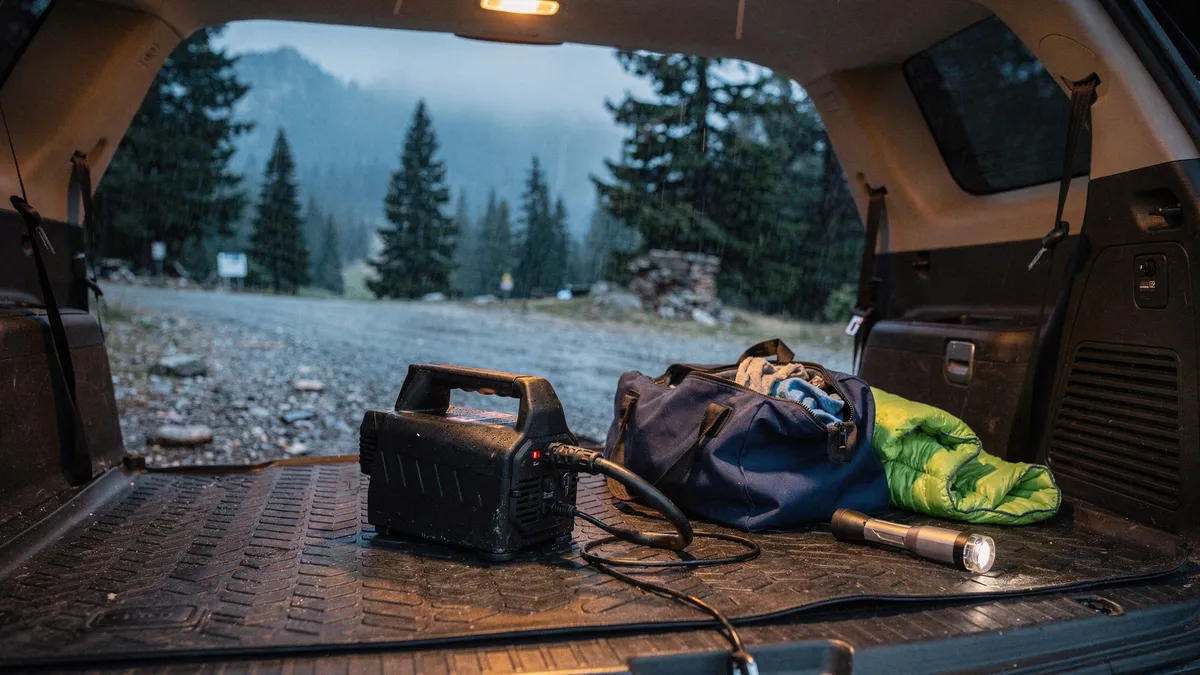
Lithium jump starters replaced the second-car-and-cables ritual with a battery pack the size of a paperback. The NOCO Boost Plus GB40 is the default recommendation at $99.95 as of mid-2026: 1,000 peak amps, rated for gas engines up to 6.0 liters and diesels up to 3.0, spark-proof with reverse-polarity protection, water resistant, and doubling as a flashlight and USB power bank. Roughly 20 starts per charge means one charge-up covers a season of family emergencies. Who it is for: essentially every driver of a car, crossover, or small truck. The honest limitations: it will not reliably crank large diesel pickups, for which NOCO's bigger GB70 at around $200 is the right tool, and like all lithium packs it self-discharges, so it needs a top-up charge every few months and hates being baked in a summer glovebox.
Tire pressure: know what your car already does
Every new passenger vehicle sold in the US has included a factory tire pressure monitoring system since the 2008 model year, so most drivers do not need to buy one. What the factory system typically will not do is show per-tire numbers on older cars, or cover anything you tow. That is where aftermarket systems earn their keep. For RVs and trailers, TireMinder is the established name; its current i10 system starts at $309 as of mid-2026 and monitors the truck and trailer together, with screw-on sensors and alerts for pressure and temperature. Who it is for: anyone towing long distances, where a trailer blowout is both likely to go unnoticed and expensive when it does. The limitations are cost and upkeep: sensor batteries need annual replacement, and screw-on sensors have to come off for every manual pressure check. For a daily driver, a $15 quality pressure gauge used monthly covers most of the same risk.
The emergency kit: build it, do not buy it
Prepackaged roadside kits mostly bundle the cheapest possible version of each item. Building your own costs about the same and every piece is one you chose:
- Jump starter (above) or, at minimum, proper gauge jumper cables
- Compact 12-volt tire inflator and a plug kit for simple punctures
- Flashlight or headlamp with spare batteries, plus reflective triangles or LED flares
- Basic first aid kit, work gloves, a multi-tool, duct tape
- Water, a couple of shelf-stable snacks, a phone cable, and a blanket in winter climates
Tailor the last items to your geography: an ice scraper and traction aid where it snows, extra water where it does not rain. A store-bought kit is an acceptable starting skeleton if building one is the obstacle; just upgrade its cables and flashlight the same week.
What to skip
A few categories earn their reputation as gimmicks. Four-channel camera arrays are overkill for a commuter car. Headlight-mounted accessory strips and cabin gadget clutter add distraction, which is the one risk factor you fully control. And ranked honestly, the cheapest upgrade in this entire article is free: the fifteen seconds it takes to check your tires and mirrors before a long drive. Buy the dash cam and the jump starter first, add the tire monitor if you tow, and let the rest of the gadget aisle keep its mysteries.