Solar garden lights earned their popularity the honest way: they got dramatically better while wired landscape lighting stayed expensive. A decade ago the solar stake light was a punchline, a dim blue glow that died by 10 p.m. and permanently by November. The current generation runs warmer, brighter, and longer, and the reason people keep buying them is simple. There is no trench, no conduit, no electrician, and no line on the utility bill. You push a stake into dirt and the yard is lit.
That convenience is real, and so are the ways the category still disappoints people. This guide covers what actually changed in the technology, how to read a listing so you do not buy 2015-era junk, two products worth their price as of mid-2026, and the placement mistakes that make even good lights look bad.
What changed, and what still has not
Three components decide everything about a solar light: the panel, the battery, and the LED. Panels got cheaper and more efficient, LEDs now sip so little power that a small battery lasts all night, and manufacturers finally started shipping warm white light around 3000K instead of the cold blue that made lawns look like parking lots.
The component that still fails first is the battery. Most path lights run on a single rechargeable AA or AAA cell, usually NiMH, and that cell degrades after one to three years of daily full cycles. Here is the part listings rarely advertise: on many models the battery compartment opens with a screwdriver, and a fresh $2 cell resurrects a "dead" light completely. Before buying, check whether the battery is replaceable. Before throwing a dim light away, check whether it just needs the new cell.
The other permanent physics problem is winter. Short days and low sun angles mean less charge, so a light that glows for ten hours in July may manage four in December. Snow on the panel means zero. No brand has solved this, whatever the listing copy implies.
How to read a listing without getting burned
- Lumens, stated per light. Path lights between 10 and 30 lumens give a gentle marker glow. Ambience, in other words, rather than illumination. If you need to actually see the ground, look for 30 lumens and up, or use a wired or hybrid fixture at the stairs.
- Color temperature. Warm white, 2700K to 3000K, flatters plants and brick. Listings that omit the number are usually hiding a cold white LED.
- An IP rating of IP65 or similar. This is the dust and water-jet resistance claim. Anything unrated will let rain into the electronics eventually.
- Replaceable battery, per the section above. This one line item roughly doubles the useful life of the purchase.
- Materials. Sub-$4-per-light multipacks are thin ABS plastic with push-in stakes that snap in compacted soil. Metal and glass construction costs more and survives the string trimmer.
Two buys that hold up
GIGALUMI 10-pack pathway lights, around $36
The GIGALUMI 10-pack of LED solar pathway lights sells for $35.99 direct as of mid-2026, which lands in the sweet spot between disposable multipacks and boutique fixtures. You get metal and glass housings rather than bare plastic, a warm glow that scatters a pleasant pattern on the ground, and enough units in one box to line a full walkway, which matters because path lighting looks intentional in rows and random as singles. Who it is for: anyone lighting a path or bed edge on a normal budget. The honest limitation: these are marker lights of modest brightness, and their pattern-glass look is decorative. If you want a clean architectural beam or enough output to read a house number by, this is not that fixture.
Brightech hybrid solar string lights, around $79
For patios and pergolas, string lights do the ambience work, and the chronic solar complaint is dim bulbs by midnight. Brightech's RGB hybrid plug-in and solar string lights, $79 as of mid-2026, hedge that bet with a dual power design: run them off the panel on sunny weeks, or plug them in when you want guaranteed full brightness for a party. Color modes are there if you want them, and plain warm white is there when you come to your senses. Who it is for: renters and patio owners who want string lights without committing to an outlet, plus the option of one. The honest limitation: the hybrid feature only helps if an outdoor outlet exists within reach, and in pure solar mode they inherit every winter limitation described above.
Two names worth knowing beyond these picks: Gama Sonic builds premium cast-aluminum solar lamps and post lights, commonly $100 and up per fixture, for people replacing wired fixtures rather than staking accents. Meanwhile Hampton Bay, Home Depot's house brand, fields well-reviewed metal path lights in the middle of the price range and is easy to find in person.
Placement is half the product
Most bad reviews of good solar lights describe placement problems. The panel needs six or more hours of direct sun, so a light under a maple tree or a roof eave is a paperweight regardless of price. Watch the yard for a day before installing: morning-only sun on the east bed, afternoon blast on the west fence. Put lights where the sun already is, or buy models with a separate panel on a cord so the light can sit in shade while the panel sits in sun.
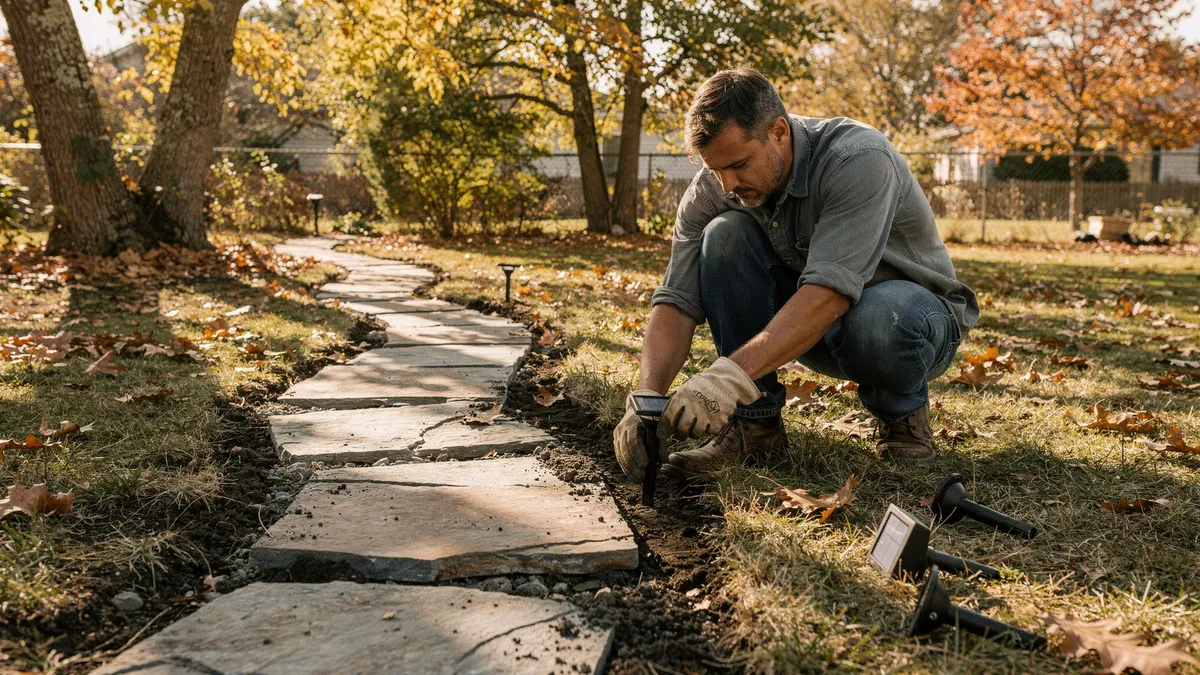
Spacing matters as much. Lights every six to eight feet along a path read as a welcoming line; lights every two feet read as a runway. Keep stakes a few inches back from lawn edges, both for mower clearance and because grass will happily grow over a low panel by July. And angle panels to face the sun's arc rather than straight up, especially outside of summer, since a flat panel wastes the low winter sun it needs most.
Care that takes ten minutes a season
Wipe the panels with a damp cloth every month or two, because pollen and dust measurably cut charging. Pull lights before the first hard freeze if your soil heaves, or at minimum clear snow off panels after storms. Swap batteries at the first sign of shortened runtime instead of tolerating two dim years. That small routine is the whole difference between owners who say solar lights last one season and owners quietly running the same set in year four.