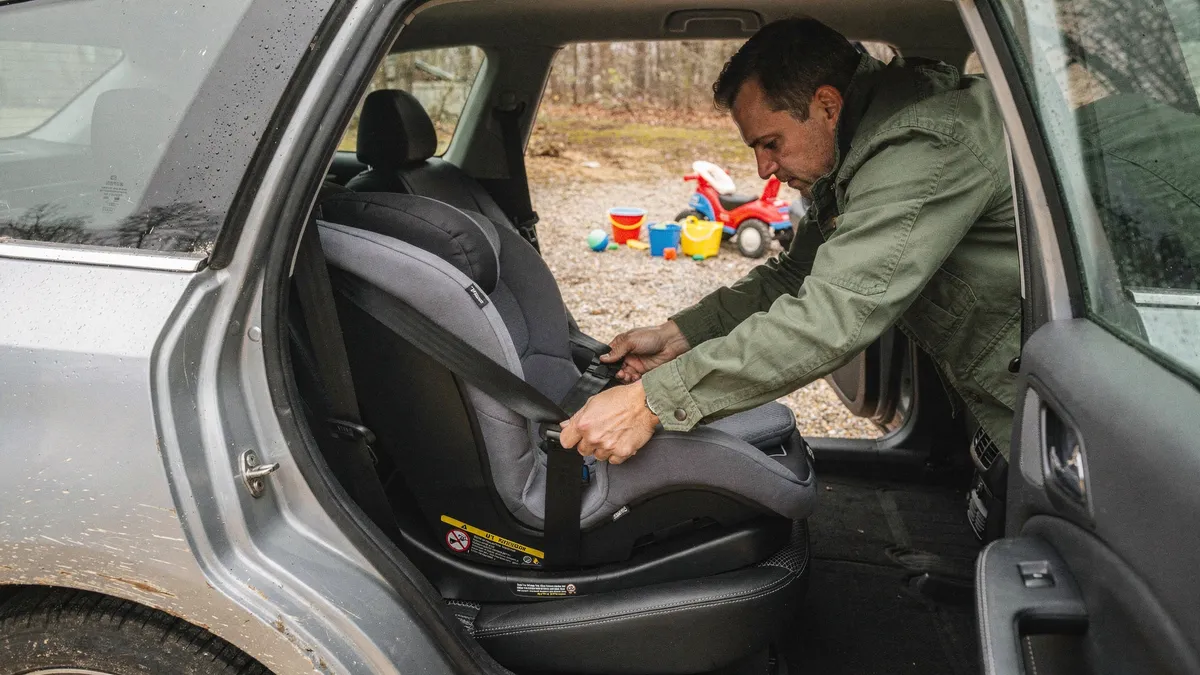
Convertible Car Seats for Growing Families: here's what actually helps. As your child grows older and taller, one type of car seat will meet your needs less well and another type will become more appropriate. The transition ages depend on your child's size and the design of the seats themselves.
Why Convertible Car Seats Help Families Save Money and Reduce Waste
The change from rear-facing infant seats to forward-facing toddler seats typically happens when a child reaches the weight or height limit for rear-facing travel in his infant seat, usually sometime between the ages of one and three. Some parents skip the infant seat and put their babies in convertible seats from day one; although this practice isn't ideal, it's safer than incorrectly positioning a newborn in a forward-facing seat.
Convertible seats, which can be positioned either rear- or forward-facing - are growing in popularity because they grow with a child and reduce the need to buy multiple seats. This also reduces the amount of garbage created when a seat wears out or becomes obsolete. Parents also save money by eliminating the need to purchase both an infant seat and a toddler seat.
How Long Should a Child Stay in a Convertible Seat
Children should ride in car seats until they reach the weight or height limit of their particular seat. According to the American Academy of Pediatrics (AAP), children should ride in rear-facing seats as long as possible, up to the maximum weight or height for their seat, before switching to a forward-facing seat with a harness and tether. Children should ride in a harness until they exceed the weight or height limit for that seat, which will happen between the ages of four and seven.
Older children should ride in booster seats until they can properly wear the vehicle's lap and shoulder seatbelts. Typically - this happens when the child is eight to twelve years old. Children under the age of thirteen should always sit in the backseat.
Facing the Backward Option: Benefits and Challenges
The American Academy of Pediatrics recommends that children ride rear-facing until age two, or until they reach the highest weight or height limit for their rear-facing car seat. Many car seats today allow children to ride rear-facing to 35 pounds or more, some to 45 inches tall or more. Some convertible seats can be used in the rear-facing position for five to ninety pounds.
Riding rear-facing is much safer for young children than riding forward-facing. In a frontal crash , a rear-facing seat distributes the force of the crash over the entire seatback, while a forward-facing seat concentrates the impact on the child's vulnerable neck and spine.
When a child reaches the weight or height limit for the rear-facing seat - he should graduate to a forward-facing seat with a harness and tether. The AAP estimates that children under sixteen years of age spend an average of forty-five to fifty minutes per day in a vehicle. For a two-year-old, this can mean over three hundred hours of backward-facing time per year.
Parents may find it awkward to buckle and unbuckle a child into a rear-facing seat, particularly if it's installed in the middle seat. Some car seats have features to make buckling easier or address other concerns. One convertible seat is designed to rotate easily in its base, allowing the parent to swing the seat around to face the rear or the front. Another seat offers an extended canopy that allows a child to nap without being disturbed by light entering through the rear window.
It may be difficult to properly install some car seats when they're facing backward. One seat, for example - is rated poor for ease of use in the rear-facing position but very good for ease of use in the forward-facing position. A convertible seat may not lie flat in the rear-facing position in some cars. This is particularly likely to be a problem in newer minivans with sloping floors.
In addition, some seats may not fit into certain cars at all when they're in the rear-facing position. We recommend measuring your car seats and your car's seating area to ensure a proper fit before you buy.
Key Features to Consider When Choosing a Convertible Car Seat
The LATCH system makes installing car seats easier. LATCH stands for Lower Anchors and Tethers for CHildren. It attaches the car seat directly to the vehicle, eliminating the need to thread the car's seatbelt through the seat. LATCH consists of two components: the lower anchors, which attach to the car seat's attachment points in place of the seat belt, and the top tether - which secures the forward-facing seat to the vehicle frame and prevents it from tipping forward in a crash.
Nearly all passenger vehicles and all car safety seats made on or after September 1, 2002, are equipped to use LATCH. However, some car seats are difficult to secure with LATCH, and some vehicles present problems - too. LATCH has a weight limit, and some older seats don't specify how much weight the LATCH system can carry before the owner switches to using the vehicle's seatbelts to secure the seat. LATCH makes it easier to properly position some car seats, but it can't be used for booster seats, which are designed to be used with the vehicle's seatbelts.
Further reading
- https://www.consumerreports.org/babies-kids/car-seats/best-convertible-car-seats-a1923302931/
- https://pmc.ncbi.nlm.nih.gov/articles/PMC4551077/
- https://thecarseatlady.com/rear-facing-convertibles/
- https://www.babygearlab.com/topics/vehicle-safety/best-convertible-car-seat
Disclaimer
This article is a personal reflection shared for general informational purposes only. It is not financial, investment, insurance, or tax advice. For decisions about your own money, please consult a qualified financial professional.