Preschool and pre-K are excellent opportunities for children to begin learning social skills and early academic lessons that will help them perform better in elementary school. While your child may attend preschool or pre-K, you might want some additional learning activities for them to try at home.
Why Educational Activity Books for Preschool Practice Can Help Children Succeed
High-quality early care and education (ECE) programs provide warm, responsive relationships with educators, stimulating and developmentally appropriate curricula, and ongoing training for educators. Research shows that ECE can help children learn foundational skills for reading - math, self-control, and positive relationships. The benefits of high-quality ECE for a child often last into kindergarten, and some studies show lasting effects into middle school and high school.
Some studies show that participating in high-quality ECE yields long-term advantages for individuals and society, including higher educational attainment - better adult health, and less involvement in crime. Yet in 2022, about 59 percent of 3- to 5-year-olds were enrolled in school overall. The total enrollment rate for 5-year-olds was 84 percent, compared to 47 percent for 3- to 4-year-olds.
If you want your child to get ahead before they start elementary school or if you would like them to continue learning during school breaks, consider using educational activity books for kids that focus on reading - math, writing, science, or another subject. While completing fun learning activities at home can benefit a child, it's not a replacement for quality preschool or pre-K programs.
What you have to understand is that activity books work best when a parent or caregiver sits with the child and talks through the activity, and so the book itself is not doing the work on its own but is giving you and your child something to do together. The simple fact is that a child who gets a warm response when they try a new skill is more likely to keep trying, and that is true whether the skill is tracing a letter or cutting along a line. Keep in mind that doing a short activity together a few times a week is more useful for most children than doing a long session once in a while.
Fine Motor Skills Worksheets and Activities
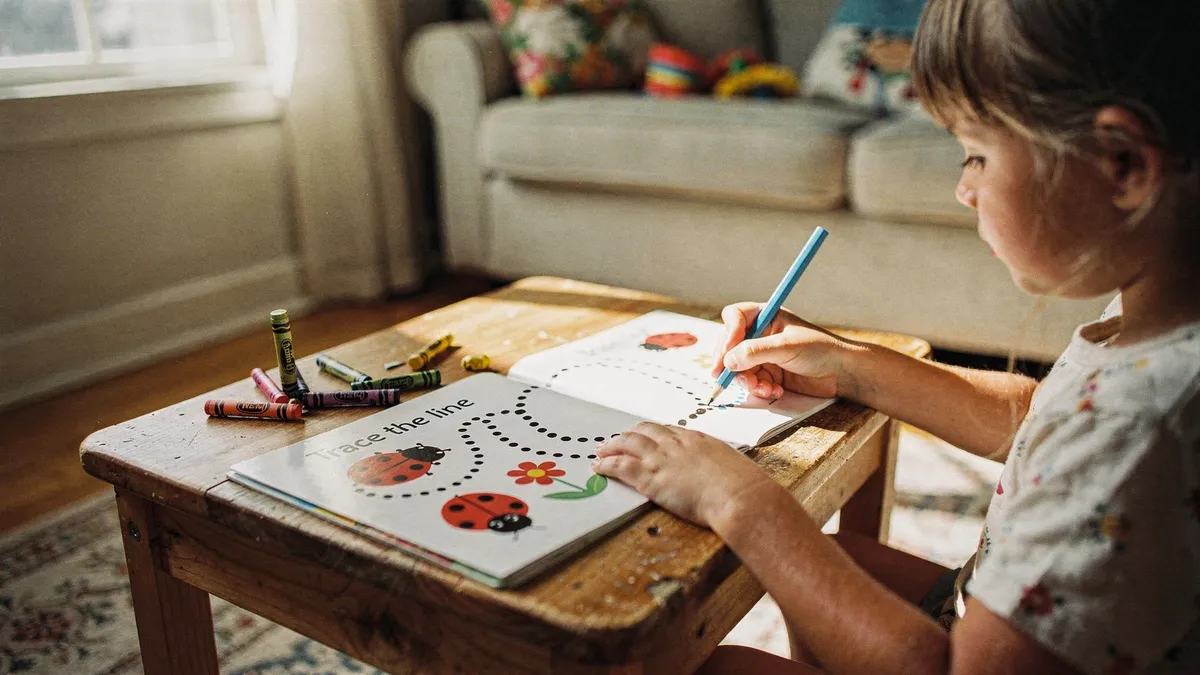
Fine motor skills worksheets are designed to increase hand-eye coordination - grip strength, and precision. These worksheets can feature mazes, connect-the-dots, or ask children to trace lines or shapes such as letters or numbers. Fine motor activities can help develop fine motor skills in children through increased exposure and practice time.
Many free printable fine motor skills worksheets are available in PDF format or as activity ideas with pictures. These worksheets and activities can help kids learn how to use scissors and cut along lines, trace letters or shapes - and color within the lines.
What you have to understand is that fine motor skills develop through repeated small movements and so a child needs many chances to practice gripping, pinching, and pressing before those movements feel natural. A common mistake is expecting a child to complete a fine motor worksheet neatly on the first try, but for most children the early attempts will look messy and that is normal and expected. The fix is to treat the early attempts as practice and not as a test, and to keep the sessions short so the child's hand does not get tired and the child stays willing to try again.
Pencil Control and Hand Strengthening Worksheets
Pencil control worksheets help students improve dexterity and refine spatial awareness. Children can practice pencil control by tracing shapes, letters, or pictures. They can also draw lines or shapes, connecting dots or finishing pictures.
Free printable hand strengthening activities are available for kindergarten and up. Younger children can complete activities such as tracing lines or shapes. Older kids can complete dot-to-dot worksheets, trace letters - or use stencils to form words or pictures.
Keep in mind that the way a child holds a pencil in preschool tends to carry forward, and so it is worth showing your child a basic grip early on rather than correcting a habit later. A common mistake is letting a child press very hard on the paper because the child thinks pressing harder makes the line better, but what you have to understand is that pressing too hard tires the hand quickly and makes it harder to control the pencil. For most children a gentle reminder to hold the pencil lightly is enough to help, and you do not need any special tool to practice this.
Cutting Practice Worksheets
Worksheets for cutting practice can help children learn how to use scissors while improving fine motor skills and hand-eye coordination. Kids can begin by cutting along straight lines and gradually advance to cutting around shapes or along more complex patterns. Some cutting practice worksheets for preschool and kindergarten ask children to cut and paste pictures or objects to make patterns, match items that go together, or tell a story.
Free printable scissor practice worksheets are available to help children get better at cutting. Many printable scissor practice worksheets ask children to cut along straight or wavy lines or around simple shapes. More advanced worksheets ask children to cut out geometric shapes or trace and cut pictures of objects, animals, or people.
What you have to understand is that many children grip scissors the wrong way at first and so the cutting practice ends up being less useful than it should be, and the child can also get frustrated and want to stop. The common fix is to have the child sit at a table with their elbow bent at their side so the scissors stay level, and for most children this small adjustment makes cutting along a line much easier. Keep in mind that left-handed children need left-handed scissors or the cutting practice worksheet will not help them much no matter how much they practice.
What To Look For in Early Learning Workbooks
Early learning workbooks should engage children and encourage them to complete age-appropriate activities. Preschoolers and pre-K students will enjoy workbooks with colorful illustrations and characters they recognize. Themes focusing on seasons - holidays, or things kids enjoy, like dinosaurs, sports, or princesses - can also make learning more interesting.
The best early learning workbooks for preschoolers and pre-K students offer activities that build foundational reading, writing, math, and science skills. Look for activities that help children recognize and write letters and numbers, identify shapes and colors - count, solve simple puzzles or mazes, and identify objects or animals. Workbooks with tear-out pages can make it easier to focus on one activity at a time.
Workbooks that include stickers can motivate kids to complete activities and make learning more fun. Many preschool and pre-K workbooks indicate what age or grade level they're appropriate for. However, keep in mind that some 4- and 5-year-old children may not be ready to read, write - or complete simple math problems. Before purchasing an early learning workbook, consider your child's reading level, maturity, interests, and whether they attend preschool or pre-K.
The simple fact is that a workbook that is too advanced for your child will not help your child learn and it can actually make your child feel bad about trying, and so matching the workbook to your child's current skill level matters more than matching it to your child's age. A common mistake parents make is buying a workbook labeled for a certain age and then pushing the child to finish every page even when the child is not ready, and that can turn a learning activity into a stressful one. What you have to understand is that it is fine to skip pages or come back to a workbook later when your child has had more practice.
Free Printable Worksheets and Online Resources
In addition to purchasing printed workbooks - there are many free printable worksheets available online that you can complete with your child. There are also websites that allow children to complete activities online or play educational games.
Keep in mind that screen time for young children adds up quickly and so if your child is completing online activities you want to set a time limit and sit with your child so the activity stays focused. The simple fact is that a printed worksheet your child can hold and write on gives your child a different kind of practice than an online game does, and both types have their place but they are not the same thing. On top of that, free printable worksheets vary a lot in quality and so it is worth looking at the worksheet before you print it to make sure the activity is actually appropriate for your child's age and skill level.
What People Get Wrong
A lot of people think that more worksheets and more practice time will always produce better results, but the simple fact is that young children learn best in short sessions and pushing a child to do too many pages in one sitting usually just makes the child tired and less willing to try the next time. People also think that if a child can complete a worksheet quickly then the worksheet was too easy and a waste of time, but what you have to understand is that building confidence with easier tasks is part of how young children learn to try harder tasks. On top of that, some parents think that activity books alone can replace preschool or pre-K, and that is not how it works because activity books are a supplement and not a full program. Another common mistake is thinking that a child who struggles with fine motor worksheets is behind in a serious way, but for most children fine motor skills develop at different rates and a little extra practice at home is usually all that is needed, though you should talk to your child's doctor or teacher if you have ongoing concerns.
What This Does Not Cover
This article covers general home practice with activity books and worksheets for typical preschool-age children and so it does not cover children who have been identified with developmental delays, learning differences, or conditions that affect fine motor skills or attention. If your child has any of those situations then the advice here may not apply in the same way and you should talk to your child's pediatrician, occupational therapist, or early intervention specialist before relying on general activity books as a main tool. On top of that, this article does not cover how to formally assess your child's readiness for kindergarten or how to choose a preschool program, and those are separate decisions that a qualified educator or your child's doctor can help you with.
References
- that ECE can help children - acf.gov
- 59 percent - nces.ed.gov
- activities can help develop fine - yourtherapysource.com
- worksheets help students improve dexterity - superstarworksheets.com