Sticker price is the least useful number on a big purchase, and it is the only one stores show you. A $500 machine you use every morning for five years costs pennies per use. A $500 machine that migrates to the garage in March costs $500 per regret. The arithmetic that separates the two takes about thirty seconds, and almost nobody does it before buying. This article is about doing it, honestly, with three real products worked through.
The arithmetic, and the one rule that makes it honest
Price per use is exactly what it sounds like: the total cost of owning a thing, divided by the number of times you will actually use it.
- Start with the full price, including tax, accessories you cannot skip, and consumables for the first year.
- Estimate uses per week. Then cut that estimate in half. This is the rule that makes the method honest, because every buyer forecasts their future self as a better person than their past self has ever been. Your past behavior with similar purchases is the only evidence you have. Use it.
- Multiply out to uses over the years you expect to own it, and divide.
Then compare the result to the cost of the alternative you are replacing: the cafe drink, the rental, the cheaper version, the service you pay someone else for. That comparison, not the sticker, is the decision.
Worked example one: the espresso machine
The Breville Bambino Plus lists at around $500 as of late 2026, and it regularly sells closer to $400. Take the sale price, add roughly $150 a year in beans for a daily drinker, and look at two owners.
The optimistic forecast says two drinks a day. The honest forecast, for someone who currently buys a cafe latte four times a week, is that same four to six drinks a week, because a machine changes where your habit happens, not how big it is. Call it 250 drinks a year. Over four years that is 1,000 drinks against $400 for the machine and $600 of beans, exactly $1 per drink. The cafe version of the same thousand drinks costs $6,000 or so at late 2026 prices. The machine wins by a wide margin even under the pessimistic forecast, which is why home espresso is one of the rare category purchases that survives honest math.
Now run the failure case, because the method requires it. If you drink coffee mainly for the ritual of leaving the house, the machine does not replace those purchases at all. It adds $400 to them. Price per use only works when the use is real substitution.
Worked example two: the boots
The Blundstone 550 runs around $220 as of late 2026. The comparison is a $60 pair of fashion boots. The wear pattern is the same in both cases: fall through spring, four days a week, call it 140 wears a year.
The cheap pair typically looks tired after one season and gets replaced. That is $60 for 140 wears, about 43 cents per wear. Blundstones commonly last five seasons or more of the same duty with occasional care, which is 700 wears against $220 plus maybe $20 of leather conditioner: about 34 cents per wear. The expensive boot is the cheaper boot, and you spend five years in the more comfortable of the two.
Notice how close those numbers are, though. If the cheap pair lasted two seasons, it would win the pure math. Durability claims deserve skepticism, and price per use should never carry a premium purchase alone. What tips this case is that the per wear costs are nearly equal while the experience is not. When the math is a tie, buy the one you will enjoy owning.
Worked example three: the stand mixer, or how the math says no
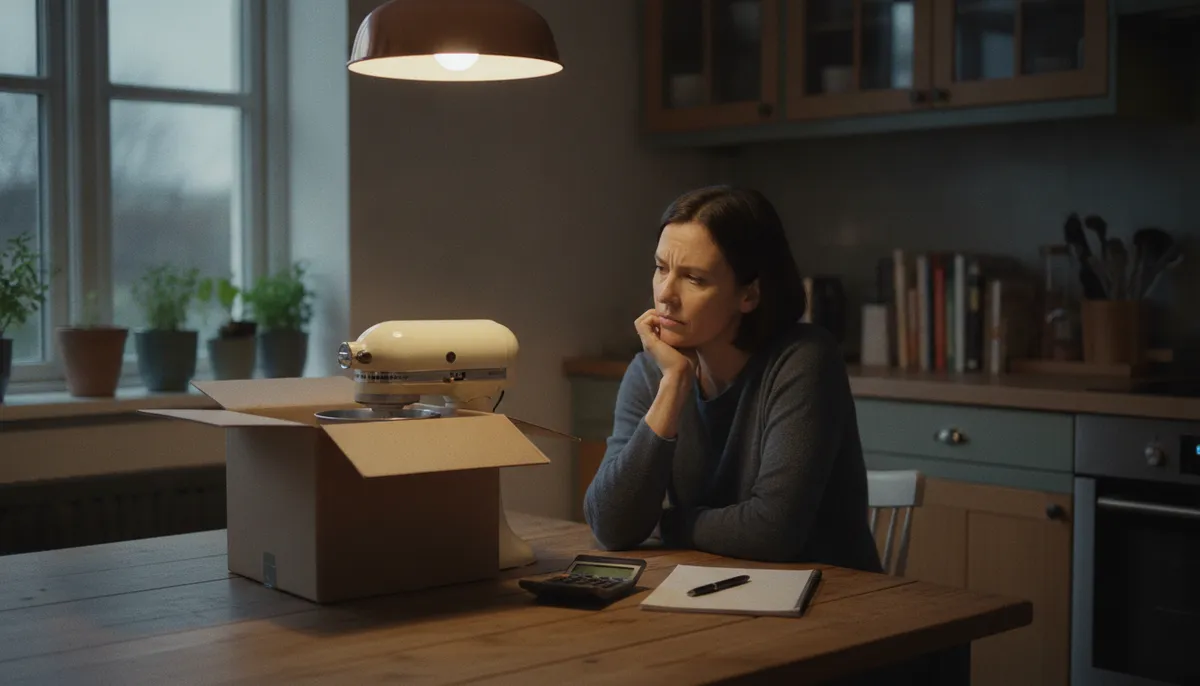
The KitchenAid Artisan 5 quart, the mixer on half the counters in America, lists around $450 as of late 2026 and frequently sells near $300. It is a genuinely excellent machine that will outlive its warranty by decades. It is also the cleanest example of the method returning a verdict people do not want.
The optimistic buyer imagines weekly baking. The honest record, for most households, is holiday cookies, a few birthdays, and the occasional ambitious weekend: perhaps 15 uses a year. At the sale price, the first year costs $20 per use. Even across ten faithful years that is $2 per use for a task a $25 hand mixer performs adequately at those volumes. The stand mixer earns its price at 100 or more uses a year, which describes people who bake bread weekly or cook for crowds. For everyone else, the math says the hand mixer, and it says it clearly.
None of this makes the KitchenAid a bad product. It makes it a specialist tool sold as a household default, and price per use is the instrument that reveals the difference.
Where the method lies to you
Three corrections keep the numbers honest. First, aspirational uses are not uses. The exercise bike forecast built on the person you plan to become in January has emptied more wallets than any scam. Second, count the costs of ownership that are not money: a bread machine that occupies a quarter of your counter charges rent in annoyance, and that rent belongs in the price. Third, subtract honest resale value for things that hold it. Quality tools, cast iron, and certain furniture return a chunk of their price when you exit; trend driven electronics return almost nothing.
One more correction runs the other way. Some purchases are insurance rather than tools, and dividing by uses misjudges them. A fire extinguisher at zero uses was still worth buying. For insurance shaped things, price the bad day it prevents instead.
Run your own number
The whole method fits in one sentence: real price, divided by honest uses, compared against the alternative. It takes half a minute, it works in the store aisle, and it is most valuable exactly when the purchase is exciting, because excitement is what inflates the forecast.
Try it with something you are weighing right now. It opens with the boots from example two, purchase price alone, which is why it lands a few cents under the with-conditioner figure above. Illustrative only.
If the number that comes out embarrasses the purchase, believe the number. It is built from your own history, and unlike the product page, it has no reason to flatter you.