At 2am, with a baby who was almost asleep until the dog barked, a white noise machine feels less like a gadget and more like survival equipment. It is worth being clear-eyed about what these machines are, though: they are sound-masking devices. They do not teach a baby to sleep, and no responsible guide should promise that a $30 speaker will fix a sleep situation. What they reliably do is blur the household sounds that wake a lightly sleeping infant, the door hinge, the sibling, the garbage truck, and give a consistent audio cue that the family can bring to hotels and grandparents' houses. Here is how to use one sensibly, and three specific machines that cover most families.
Use it safely: distance and volume before features
Sound safety is the part of this category that deserves the most attention and gets the least. The American Academy of Pediatrics has warned broadly about excessive noise exposure in children, whose ears are more vulnerable than adults', and notes that research has raised concerns about the sound levels infant sleep machines can produce. The practical takeaways are simple and free. Place the machine well across the room, never in or on the crib. Run it at a moderate volume, low enough that you could still comfortably hold a conversation next to it; if you have to raise your voice near the machine, it is too loud. Use the lowest volume that actually masks your household noise rather than defaulting to maximum, and remember the machine is there to cover sound spikes, so it does not need to be loud in a quiet house.
Sound is also only one piece of a safe sleep setup. The AAP's parent guide to safe sleep covers the fundamentals, back sleeping and a bare, flat sleep surface among them, and is worth ten minutes of any new parent's time before optimizing the audio.
Hatch Rest (2nd Gen): the nursery hub
The Hatch Rest has become the default nursery machine, and the reasons are practical: it combines white noise, a color-adjustable night light, and a time-to-rise signal in one plug-in unit, all controlled from your phone. Being able to nudge the volume down or shift the light without opening a creaky door is genuinely useful, and the time-to-rise light earns its keep years later with a toddler who cannot yet read a clock. It lists at $69.99 as of mid-2026. The honest limitation is the subscription: the machine works fine out of the box, but Hatch gates its larger sound library and some app features behind a membership at around $5 a month, which annoys people on principle. Buy it for the light and phone control; treat the subscription as strictly optional.
Yogasleep Hushh: the portable one
The Yogasleep Hushh is a palm-sized, rechargeable machine that clips to a stroller or diaper bag, weighs a few ounces, and runs through the night on a charge. It offers three sounds and a small amber light, with none of the app business, and typically sells for around $30 as of mid-2026, often less on sale. This is the machine for naps on the move and travel, and for parents who want a backup that lives in the car. Its limitation follows from its size: the small speaker produces a thinner sound than a plug-in unit, and like anything rechargeable it will eventually be found dead at the worst possible moment. Families who love theirs usually end up with one stationary machine and one Hushh.
LectroFan EVO: the no-nonsense masker
The LectroFan EVO takes the opposite philosophy from Hatch: it skips the app and the light entirely and spends its whole budget on unusually good noise. It generates its sounds electronically rather than looping a recording, so there is no seam or repeat for your brain to latch onto, and it offers a range of white, pink, and brown noise variants plus fan sounds, with fine-grained volume control. It costs about $50 as of mid-2026. It suits parents who find deep, low-frequency masking works better against traffic or thin walls, and it doubles as an adult sleep machine when the nursery phase ends. The limitation is exactly its plainness: no night light, no remote control, and adjusting it means walking to the machine, which is the one thing nursery life teaches you to avoid.
Fitting the machine into a routine
A sound machine works best as one cue in a boring, repeatable sequence rather than as the main event. A typical version: feed, fresh diaper, sleep sack, machine on at the same moderate volume, lights down, into the crib. The machine's real value is consistency; the identical sound in the identical spot signals that sleep is next, and it travels, which is why the portable option above exists. Two practical notes from the collective wisdom of exhausted parents. Continuous noise tends to work better than programmed sounds that stop after an hour, since the masking is most useful in the early morning when sleep is lightest and the household is loudest. And if you ever want to reduce reliance on the machine, doing it gradually, a notch quieter every few nights, goes better than quitting cold.
Room-sharing and siblings
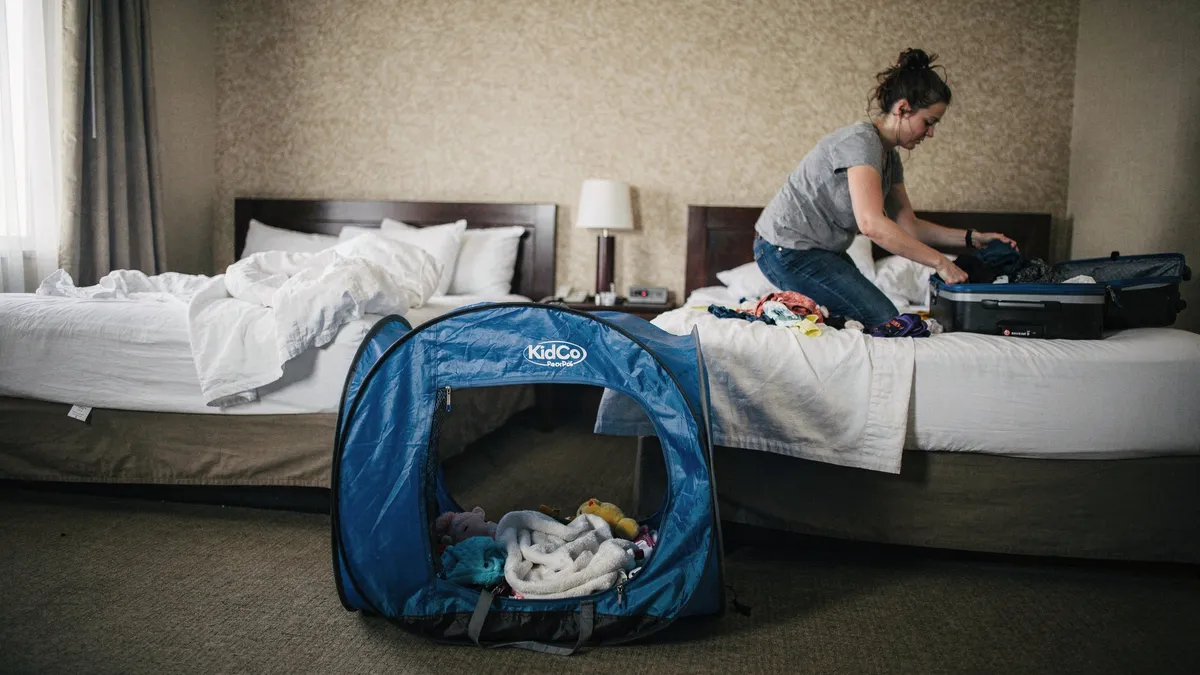
Two situations make a machine earn its price several times over. In the room-sharing months, when the crib or bassinet is in the parents' room, a machine placed near the adult side masks the rustling, whispering, and phone-checking that would otherwise wake the baby, and it masks the baby's harmless sleep grunts that would otherwise wake the parents; newborns are loud sleepers, and responding to every squeak helps nobody. Later, when a toddler and a new baby share a wall or a room, a machine on each side of that wall is the cheapest peace treaty available. In both cases the same volume rule applies: moderate, steady, and no louder than the problem it is solving.
What to skip
Skip machines that only run at loud volumes, anything without a volume dial or steps, and crib-mounted soothers that put the speaker inches from a baby's head, which runs against the distance principle above. Be skeptical of models advertising womb-simulation science or sleep guarantees; a masking device has one job. And if a machine, an app, and a subscription start to feel like a second mortgage on a white noise habit, remember that a $30 Hushh and a consistent routine cover the actual requirements. The machine buys you quiet; the routine does the rest of the work.